
The sun’s rays and your skin have a complex relationship — one that can impact your health more than you might think. Whether you’re walking to class, lounging on campus lawns, or heading to a weekend hike, your skin is constantly interacting with the sun. In this guide, we’ll explore how the sun’s rays affect your skin, what risks are involved with sun exposure, and how you can stay safe — without avoiding the sunshine altogether.
Understanding The Sun’s Rays and Your Skin
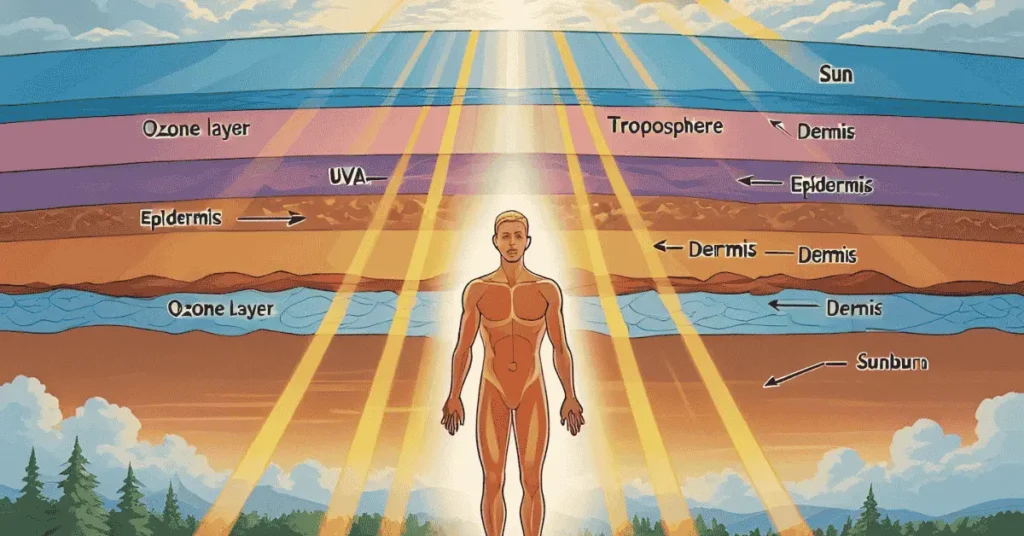
To understand the sun’s rays and your skin, we need to break down the types of ultraviolet radiation involved:
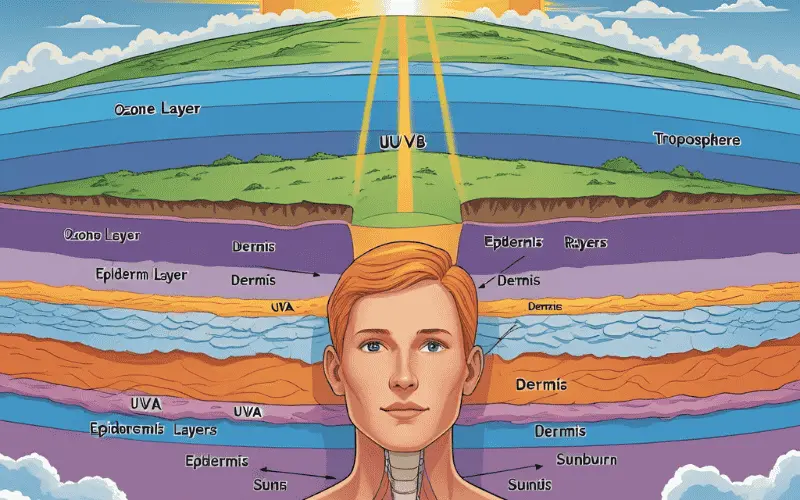
UVA rays: Penetrate deep into the dermis, the lower layer of the skin. These are responsible for long-term damage like wrinkles and photoaging. UVB rays: Cause visible skin damage like sunburn. These rays directly affect your skin’s surface, the epidermis. UVC rays: Dangerous but don’t reach the Earth’s surface thanks to the ozone layer.
The sun’s rays and your skin interact daily — even on cloudy days or during winter. UVA and UVB radiation can still cause UV damage, so protection matters all year round.
Key Information About the Sun and Its Effects on Earth
| Category | Key Details |
|---|---|
| Sunlight and Color | – The Sun emits light across the visible spectrum. – From space or high in the sky, the Sun appears white, with a CIE color index near (0.3, 0.3). – Radiance peaks in the green portion of the spectrum. – When low in the sky, atmospheric scattering causes colors like yellow, red, orange, magenta, and rarely green or blue. |
| Cultural Perception | – Some cultures picture the Sun as yellow or red, although the reasons are culturally debated. |
| Solar Classification | – The Sun is a G2-type star. – “G” refers to G-type, and “2” refers to its surface temperature range. |
| Solar Constant & Irradiance | – Solar constant = ~1,368 W/m² at 1 AU (Earth’s orbit). – On Earth’s surface: ~ 1,000 W/m² due to atmospheric attenuation. |
| Solar Spectrum at Atmosphere Top | – 50% infrared, 40% visible, 10% ultraviolet light. |
| UV Light & Biological Effects | – UV is filtered >70% by the ozone layer. – Causes sunburn, vitamin D production, tanning, and skin cancer. – Has antiseptic properties (can sanitize tools and water). – Influences human skin pigmentation variation through adaptation. |
| Ionosphere Formation | – Solar UV radiation ionizes the upper atmosphere, forming the ionosphere. |
| Energy Transport in the Sun | – Gamma rays produced by core fusion are absorbed and re-emitted many times. – Photon travel time to surface: 10,000–170,000 years. – Full energy transport time scale: ~30 million years. |
| Neutrinos | – 2.3 seconds to reach the surface. – Make up ~2% of solar energy output. – Rarely interact with matter, escape immediately. – Electron neutrino deficit solved in 2001 by discovery of neutrino oscillation (they change flavor during travel). |
Short-Term Effects: How The Sun’s Rays Affect Your Skin Right Now
Sunburn
One of the most immediate impacts of the sun’s rays on your skin is sunburn. This happens when UVB rays damage the outer layer of the skin, the epidermis, causing redness, pain, and inflammation. This reaction, known as erythema, is your body’s response to UV damage.
Tanning
Tanning may seem harmless or even desirable, but it’s a warning sign that the sun’s rays are harming your skin. A tan is your body’s way of trying to protect itself by producing more melanin. This process, called melanogenesis, occurs when UV radiation stimulates melanocytes in the skin to produce more pigment.
Irritation and Sensitivity
For people with acne, eczema, or rosacea, the sun’s rays and your skin can be a bad combo, leading to increased sensitivity or flare-ups. UV exposure can exacerbate these conditions, causing further inflammation in the skin layers.
Long-Term Impact of The Sun’s Rays on Your Skin
Premature Aging
Frequent exposure to the sun’s rays accelerates signs of aging, a process known as photoaging. Fine lines, wrinkles, and sun spots appear faster, especially if sunscreen isn’t part of your routine. This is due to UV damage to the collagen and elastin in the dermis, the skin’s deeper layer.
Skin Cancer Risk
The most serious consequence of neglecting the relationship between the sun’s rays and your skin is the increased risk of skin cancers:
Melanoma: The most dangerous form of skin cancer, originating in melanocytes. Basal Cell Carcinoma: The most common type of skin cancer, developing in the basal cells of the epidermis. Squamous Cell Carcinoma: The second most common skin cancer, arising from squamous cells in the epidermis.
It’s important to know that the sun’s rays can cause skin cancer in all skin tones — not just fair skin. While darker skin has more natural protection due to higher melanin content, it’s not immune to UV damage and skin cancer.
Sunburn, UV Radiation, and Skin Response: Key Information Table
| Category | Key Details |
|---|---|
| Sunburn Symptoms & Severity | – Initial symptoms: Redness, pain (severity depends on exposure time). – Other symptoms: Blistering, swelling, itching, rash, nausea, fever, chills, fainting. – Touch: Skin feels warm due to capillary heat. – Classification: Superficial or partial-thickness burns. Blisters indicate second-degree sunburn. – Minor: Redness, tenderness. Severe cases may require hospital care. |
| Timing of Sunburn | – Can occur in < 15 minutes. – Redness can appear in 30 minutes, but full symptoms develop in 2–6 hours. – Peak symptoms: 24–36 hours after exposure. – Healing: Usually begins in 3–5 days, full recovery in 7 days; severe cases may last weeks. |
| UV Sources | – Sunlight, tanning beds, welding arcs, UV germicidal devices. |
| Health Risks from UV | – Increases risk of melanoma, basal cell carcinoma, squamous cell carcinoma. – Melanoma risk increases with lifetime sunburn episodes. – 1/3 of melanomas in the US & Australia could be prevented with sunscreen. |
| Biological UV Effects | – UVB damages mRNA → triggers inflammatory response (via ZAK-α protein). – Immune cells are recruited; not DNA damage, but RNA damage causes quick sunburn reaction. – DNA damage: Thymine dimers form → activates repair, apoptosis, peeling, and melanin production. |
| Role of Melanin | – Absorbs UV light, preventing direct/indirect DNA damage. – Reduces mutation risk by inhibiting bond breakage and free radicals. – However, ~2,000 genomic sites are highly UV-sensitive (up to 170x more sensitive). |
| Pain Mechanism | – UV triggers production of prostanoids, bradykinin, lowering TRPV1 receptor threshold (109°F → 85°F). – Pain may result from CXCL5 protein activating nerve fibers. |
| Fitzpatrick’s Skin Phototypes | – Type 0: Albino (extremely burn-prone). – Type I: Pale white skin, burns easily, doesn’t tan. – Type II: White skin, burns easily, tans with difficulty. – Type III: White skin, may burn, tans well. – Type IV: Olive/light brown skin, rarely burns. – Type V: Brown skin, tans easily. – Type VI: Black skin, very rarely burns. |
| Age Factors | – Children <6 and adults >60 are more sun-sensitive. |
| Genetic Susceptibility | – Conditions like xeroderma pigmentosum impair DNA repair, increasing sunburn and skin cancer risk. |
How to Protect Yourself from The Sun’s Rays and Keep Your Skin Healthy
Use Broad-Spectrum Sunscreen
- Choose a sun protection factor (SPF) of 30+.
- Apply generously on all exposed skin.
- Reapply every 2 hours — especially after sweating or swimming.
Stay in the Shade
Minimize direct sun exposure during peak hours (10 a.m. to 4 p.m.). Use trees, umbrellas, or buildings as shade to reduce UV exposure.
Wear Protective Clothing
- Hats, sunglasses, and long sleeves are smart choices for sun protection.
- UV-blocking fabrics offer even better protection from the sun’s rays.
Keep Vitamin D in Mind
You don’t have to bake in the sun to get your vitamin D. A few minutes of indirect exposure is usually enough, or consider vitamin D supplements after checking with your doctor to avoid vitamin D deficiency.
🧠 Myths About The Sun’s Rays and Your Skin — Busted
Myth: “Darker skin doesn’t need sunscreen.” Wrong. The sun’s rays affect all skin tones. While melanin offers some protection, it’s not enough to prevent skin cancer or photoaging.
Myth: “Cloudy days are safe.” Wrong again. Up to 80% of UV rays still reach your skin, even when it’s overcast.
Myth: “Sunscreen blocks all vitamin D.” Not true. You can still produce vitamin D while wearing sunscreen and protecting your skin.
✅ Final Thoughts on The Sun’s Rays and Your Skin
The sun’s rays and your skin are in constant contact — and how you manage that contact determines your skin’s long-term health. You don’t need to avoid the sun completely, but you do need to respect it.
So, next time you step outside to enjoy a beautiful day, think about how the sun’s rays and your skin are interacting. Grab your sunscreen, wear your shades, and protect the skin you’re in. Remember, proper sun protection is a crucial aspect of public health and skin cancer prevention.
Your future self will thank you for taking care of your skin and understanding the importance of UV protection in maintaining healthy, youthful-looking skin.